In my four years at Pitzer I have been exposed to many study spaces across the 5Cs. I have heard complaints about Pitzer study rooms, but I wanted to discover how people really used study rooms and if there was a desire to improve. This data has been collected as part of my senior thesis project in Organizational Studies to discover what Pitzer students actually want in their study spaces in order to make them more productive and successful students. This report will shine light on the needs of students within on-campus study spaces and how .
Organizational studies put simply is the study of how humans organize themselves and the systems that they operate within. Specifically, Organizational Studies is an interdisciplinary field combining Political Studies, Sociology, Psychology and Economics to analyze how organizations operate, how they affect society, and what their lifecycle is like: how they are created, maintained, and modified. An organization could mean anything from a Fortune 500 company with a stratified hierarchy of positions, or it could mean your friend group — in this case the organization I am examining is Pitzer. Within our organizations that we participate in there are many different factors that impact the organizational dynamic — power imbalances, physical environment, interpersonal conflicts, individual identities, and much more.
With the definition of organizational studies in mind, the focus of my thesis project of examining student study spaces, physical spaces are not only important to how people create their emotional and intellectual realities, but directly correlates to where and how people organize. It is well understood within psycology that the built environment — or manmade environment — is constantly impacting our autonomic and central nervous systems. It has the power to influence not only behavioral changes, but even cellular and molecular alterations (Bower et al.). Things as simple as brightness and color of lights can impact someone's mood (Küller et al.). These subtilties show how important thoughtful student spaces are in creating belonging, academic success and a sustained love of Pitzer after graduation.
The following data was collected through a survey designed in collaboration with Professor of Organizational Studies Barbara Junisbai and Associate Dean of Residence Life and Community Standards Joe Koluder.
Going through three revisions, including reacting to feedback from Joe and Barbara, the survey gathered data using a combination of short response, long response, 5-point Likert scale, multiple choice and single choice questions. The survey was hosted using Microsoft Forms and responses were collected on a fully anonymous basis. However, access to the form was limited to Pitzer accounts and required athentication through Microsoft Entra ID using --@pitzer.edu single sign-on credentials.
Although very unlikely, due to the nature of the authentication being only limited to those with an --@pitzer.edu account, it should be noted that Pitzer faculty and staff could have accessed and responded to the survey, fraudulently pretending to be a student.
The survey was primarily marketed to students through fliers, the student talk listserv (student-talk@pitzer.edu), and word of mouth. Additionally, a volunteer marketing agent was used to solicit responses at McConnell dining hall during one meal period.
A summary of the survey and responses can be found here and the raw dataset can be accessed here.
Understanding biases in the data
Importantly, the Class of 2028 had 10% higher participation in the survey making the population a clear majority in the results. This is evidenced by a combined 24% of students lived in the WES community as a result of the Sophomore Year Experience. While this circumstance does not invalidate the results, this must be considered when evaluating the data as 10% more participation from one class population is significant enough to impact the results of the survey.
Aesthetics and ambiance
Q: "I would like study rooms more if there were Pitzer Archives installations that showed cool facts about Pitzer's history"
Fig 1. Student sentiment regarding Pitzer Archives installations in study rooms
Takeaway: 56% of students actively support the Archives exhibit and a combined 85% of students actively support or are neutral and open to the Archives exhibit. Pitzer Archives already has framed photographs presenting a low-cost way to enhance currently blank walls in study rooms. This would also enhance institutional memory and create a culture where Pitzer's roots are celebrated.
Campus Study Room Usage
Q: "Where do you live?", "Where do you use study rooms?"
| Where students live | n | Mead Library | Skandera Hall | West Halls | East Hall | Pitzer Hall | Atherton Hall | East Sanborn | North Sanborn |
|---|
Fig 5. Where students live vs where students study on-campus. y-axis represents where students live, x-axis represents where students study.
Takeaway: Data suggests that students like to study in the residence hall that they live in, if available. For example, 95% of residents in East Hall, where there is a high concentration of study rooms, also stated they used study rooms in East Hall. Conversely, 67% of North Sanborn, where there is a low concentration of study rooms, also said they use Pitzer Hall study rooms. This potential student desire for study rooms in the same residence hall they live in is a potential thread to be followed when conducting new surveys about residential study areas.
Campus Study Room Usage
It should be noted that the majority of respondents (34%) were part of the class of 2028 meaning they live in WES halls, for this reason usage location may be skewed due to class-based residential experiences.
Campus Study Room Usage
Q: "Where do you use study rooms?"
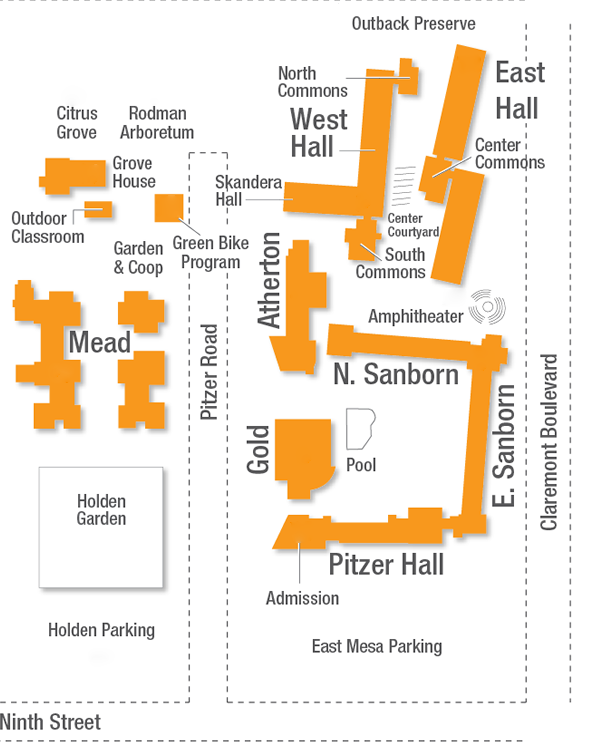
Fig 6. Map of Pitzer college with bubble overlay to represent student usage preferences
Students could select multiple locations; total selections (328) exceed survey respondents (131).
Study Room behaviors
Q: "Evaluate the following scenarios and answer based on the frequency you engage in these behaviors"
Fig 7. Student frequency of study behaviors in different locations
Takeaway: Study room usage should be increased to facilitate better work/life balance within our scholar-residence communities. 34% of students reported that they always or often use their room as their study space and 25% reported that they rarely or never use study rooms. While only 28% reported that they always or often use study rooms. Studies have found that working in a personal bedroom can lead to unhealthy associations between work and sleep (Altena et al.). Combined with extended light exposure from screens this can cause serious sleeping issues and hinder academic success.
Q: "Most often, I use study rooms to..."
student psychology and academic success
Takeaway: Responses reveal on how the physical study room environment affects emotional state during usage. 8% of respondents said that study rooms made them feel “sad”, while 6% said that study rooms make them feel "focused". In asking what students did like about the study rooms, some cited the uncomfortableness of the rooms as motivating to complete work faster. This suggests that limiting distractions while making study rooms more welcoming and having a combination of different design schemes — for independent work and collaborative work — is essential when thinking about modifying these spaces for academic success.
student desires and preferences
Q: "I would enjoy the study rooms more if..."
Takeaway: A combined 68% of students strongly agree or agree with adding furniture for independent work 71% of students strongly agree or agree with adding more comfortable furniture. This shows that there is a desire for more independent co-working designs. This would not only increase study room usage but increase how many people can use them. Additionally, 76% responded that they want soft/ambient lighting in the study rooms. Although bright lights can stimulate alertness, there is a limit and studies have found that too bright of light starts to decrease mood (Küller et al.). Changing lighting in study rooms could potentially uplift mood leading to more efficient and enjoyable study sessions.